
How to Read Classical Guitar Music
Like any other instrument, classical guitar music is written on a staff. There are great resources all over the web that teach and train reading on the staff. Notation reading should be fluent and effortless.
Starting from the bottom line of the staff, a sentence can be used to figure out each of the notes on the lines. “Every Good Boy Does Fine” is the most common sentence. “Even George Bush Drives Fast” is another. A young student came to me and he had made up his own sentence, “Elmo Gave Barny Dead Fish”


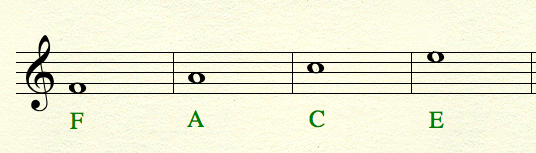
The spaces spell a word from bottom space to top: FACE.
Stop Guessing
With these tools a beginning player should never guess the note which they are going to play. It’s not about putting your fingers down and hoping, it’s about knowing. That means at the beginning stage of reading music, one should talk through the sentences or words if need be and know the notes. Often time students have a disassociation between the actual note names and where to put their fingers. Their intellectual concept of the staff is well developed but their muscle memory is not. The key is to train both at once. This can be accomplished very simply by saying the note names aloud while playing them. This works well playing melodies but fails with polyphonic music. Practice reading individual melodies, in multiple positions on the guitar, first.
Numbers, Letters, and Strange Markings
In addition to all the standard notation stuff, classical guitar music has some very specific things that go on in it. To notate left hand (LH) fingering, we use numbers:
- LH index
- LH middle
- LH ring
- LH pinky
To those former pianists (recovering pianists?) this can be a bit confusing as the thumb is normally considered 1. For the right hand (RH) we use letters:
- p = RH thumb
- i = RH index
- m = RH middle
- a = RH ring
- c = RH pinky
Most times the pinky is not used on the right hand, but sometimes a “c” pops up.
The other strange markings or words are going to be musical instructions on things such as tempo, articulation and dynamics. It’s also possible that some markings or words are indications of special or extended techniques, but most pieces of music will have a legend or key for those markings. Here is an online dictionary of music terms for your reference. It can also be helpful to have a reference around like The Harvard Dictionary of Music. If you’re still a college or graduate student check out your school library website. Most schools will have online access to the Grove Dictionary of Music and Musicians which is a tremendous resource.
The key to getting better at reading is doing more of it. Which sucks. A lot. But there’s no way around it. With all the free music (check out the free guitar music page for some sheet music and links) floating around online there should be no shortage of music to read. A book of jazz licks can also be a great way to practice reading: just play the lick in multiple positions. Good luck! and happy reading!
Zachariah Smith
Dear Christopher Davis,
I am a beginner at classical guitar, but I can play well. Though I still to master reading sheet music, and I was just wondering how do you tell the difference between notes thar look the same? For example: first fret D, sixth fret A, and eleventh fret low E all look the same when read.
Christopher Davis
Well, Zach, you can’t really tell the difference. You just pick one. This is what makes sight reading on the guitar so hard. Unless the editor/composer has written in string numbers or fingerings, there’s no way to really tell where to play it.
Christopher Davis
Hi again Zach! numbers in circles indicate strings. 1 would be the highest (first string), 6 is the lowest.
Rebecca
Thanks so much for this introduction! I’m a pianist so I can already read music but it sure helps to know the different notations for guitar. I have a question: I am learning a piece of music which seems to indicate that three strings are to be held down simultaneously with one finger. (This is really hard for me but not impossible.) Above the notes (a pair of eighth notes, the first of which is a chord) there appears a Roman numeral “II” and a dotted line extending to the second note. Does this mean anything special? It is not a chord marking because the music which I am using does not use those. Thanks!
Christopher Davis
Usually roman numerals above the staff are position indications. In that case, it’s probably an indication to barre (hold down more than one string with one finger) across the second fret. The dotted line tells you how long you’ll have to hold down the barre.
Rebecca
Thank you so much! I’ve been reading more of your blog and I love it! Keep it up.
Zachariah Smith
Hello, again. I just had another question. I was looking at some sheet music / tablature and I saw some numbers in circles right next to some of the notes. What do they mean?
Zach
Hello again! Thanks for your advice from almost a year ago. I now am playing guitar in my school band and I had a question about a piece of sheet music. It says the tempo is one half note gets 60 bpm. What the tempo name for that (like moderato, largo), and does that every quarter note gets 30 bmp. If thats true it is a very slow beat. Oh, it’s called “Ballet” by Michael Practorius if that helps, my teacher transposed it for guitar and he might have made a mistake.
Christopher Davis
The tempo would be quarter note = 120. Since two quarter notes fit into one half note, you double the tempo, not half it. Hope that helps!
Kevin Lai
Hi Zach,
While practice a sheet of studies that a friend gave me, there is a symbol “BV4” with the 4 as a subscript to some bars. I could figure out that the B = barre’, the V = 5th fret but what does the subscript “4” means? Does it mean playing only 4 strings of the barre?
Christopher Davis
Yep, that’s exactly what the subscript 4 means. You’d just barre the highest 4 strings. A subscript 3 would me you’d barre the highest 3 string, etc.
pixie
hi! i was wondering what does that mean:
1/2 C II – above the notes
Christopher Davis
1/2 = Half, C = capo (barre), II = second fret.
So a half-barre (across strings 1, 2 and 3) at the second fret.
pixie
thanks a lot!!!
Pete Welsh
HI Christopher,
I’m progressing quite well but find it a real struggle reading for the bass strings. Ledger lines confuse me as they sort of float nowhere! I can read Bass clef for piano and don’t understand why we don’t use this for guitar as reading bass note is easier this way (to me?) as they are properly placed on the staff. Anyway do you have any tips for reading notes on ledger lines?
Pete
Christopher Davis
Not really. Just takes practice!
Joao
hello, nice website you got here, i ve got a question for you: so i usually read music for guitar in tabs, but in germany i came across some good old books with tabs for guitar, and the very first chord of Bach´s Minuet I is composed by (starting from below) a G, D (open 4th string), B and an octave higher D, i would play it String#fret: 6#3, 4#0 , 3#4, 2#3, but in the partiture small numbers stand aside of the notes and GDBD comes with 3021, correspondently, i thought those numbers would be the fingers, but if you try that config it makes no sense, if the numbers were frets it also doesnt make any sense, its not string number for sure, so im a bit lost here.. can you help ? cheers